
Fluvial
Don’t call us ‘river’
as if we were singular – a
blue, serpentine line on a map,
an ‘s’ from source to estuary;
an abstraction
to be navigated,
straightened.
fished,
dredged.
A g a p i n g mouth for waste disposal.
If you must make us ‘river’, sense our communities
of muds, molluscs, marshes, mires;
of sedge-fen with Moorhen
& shy Water Rails.
Of wet woodland & carr,
where scrubby Willows touch
Tussock Sedge, Lichens, Moss.
Helen Moore – see helenmoorepoet.com to read the whole poem
You can tell a lot about a place by peering over a bridge into its river. In Orléans, France, this April, I leaned over the George V Bridge to look at the River Loire. The main river was wide, stately, and sparkling under the spring sun. But there were almost no fish visible. Just one trout-shaped outline, solitary and injured, the left side of its tail mottled with pale lesions.
From the bridge, I could see the channel bifurcate—the northern side deep and constrained for navigation, the southern side shallower, meandering through a sandy bed, tree-lined and peaceful. But even in these shallows, there was little life. No minnows, no darting shadows. A heron stood sentinel, alone.
We smelt sewage—faint but unmistakable—wafting from a manhole cover on the road close to the water’s edge on the southern side. The Loire is clear in places, but that clarity hides a murkier story. A quick search online confirmed what I feared: the Loire, like so many rivers, carries the burden of human neglect. Agricultural runoff, industrial waste, aging sewage systems. In this part of France, there’s also the legacy of lead mining and even discharges from nearby nuclear plants.
The Loire drains a fifth of France. It’s no wonder it struggles.

We hold rivers in our imagination before we ever see them. Before coming to the Loire Valley, I imagined blue, life-filled waters winding through fairytale landscapes. Châteaux perched above glimmering currents. Vineyards sweeping down green hillsides. My memory a blend of scenes from old Bond films, labels on bottles of wine, and travel documentaries.
That imprint—of a pure, perfect river—comes from childhood stories, nature programmes, perhaps even deeper ancestral memories. We imagine rivers full of fish and birds, bubbling over rocks clear enough to drink from. When the reality doesn’t match—when the river is silent and seemingly lifeless—it brings a strange grief.
But perhaps the deeper sadness is this: that we’ve come to expect so little from urban rivers. The Loire in Orléans is far from dead, but it feels diminished. Like the River Taff in Cardiff, which I know well—poisoned by farm and human effluent, choked with invasive plants, littered with plastic, its scruffy banks ignored by the thousands who pass it daily. How did we become so indifferent to rivers, these arteries that gave birth to our cities in the first place?
Living in the countryside, I think more about water. When we discovered our cesspit was overflowing into a woodland ditch, it haunted me. We tested the water downstream. Luckily, the half-mile of bog and root-filtered earth of our wood left it clean by the time it reached the stream. Still, the smell lingered in summer. We rerouted the outflow through a gravel trench along the margin of our field and into a soakaway on the edge of our wood. The grass over the trench is greener. The smell has gone. It felt like a small victory.
Urban infrastructure, by contrast, seems built on a kind of denial. Storm overflows disgorge human waste in wet weather—an accepted flaw in an aging system. Who owns that problem? No one, and everyone. It’s collateral damage for convenience, an unspoken agreement to look away.
We wouldn’t build cities this way if we started from scratch. If we had to drink from the rivers we pollute, maybe we’d care more. Maybe that’s what it would take—a national ritual of drinking from our nearest river. Nothing brings reality home like taste.
Environmental agencies write reports. They chart chemical degradation, declining biodiversity. But their warnings are often ignored. Industry continues to pollute. Cities continue to grow. And the rivers—complex, living systems with catchments spanning hundreds of thousands of square kilometres—become too sick, too vast to heal by institutional action alone.
It will take generations. That’s hard for humans to hold in mind—especially politicians, whose cycles are measured in years, not decades. That’s why restoration so often begins with community groups and stubborn individuals, doing what they can, hoping it adds up. In Wales, remarkable, stubborn, and passionate individuals like Angela Jones, a river ambassador and environmentalist, have established community groups to become thorns—pricking both Welsh Water and Natural Resources Wales with shame for failing the River Usk.
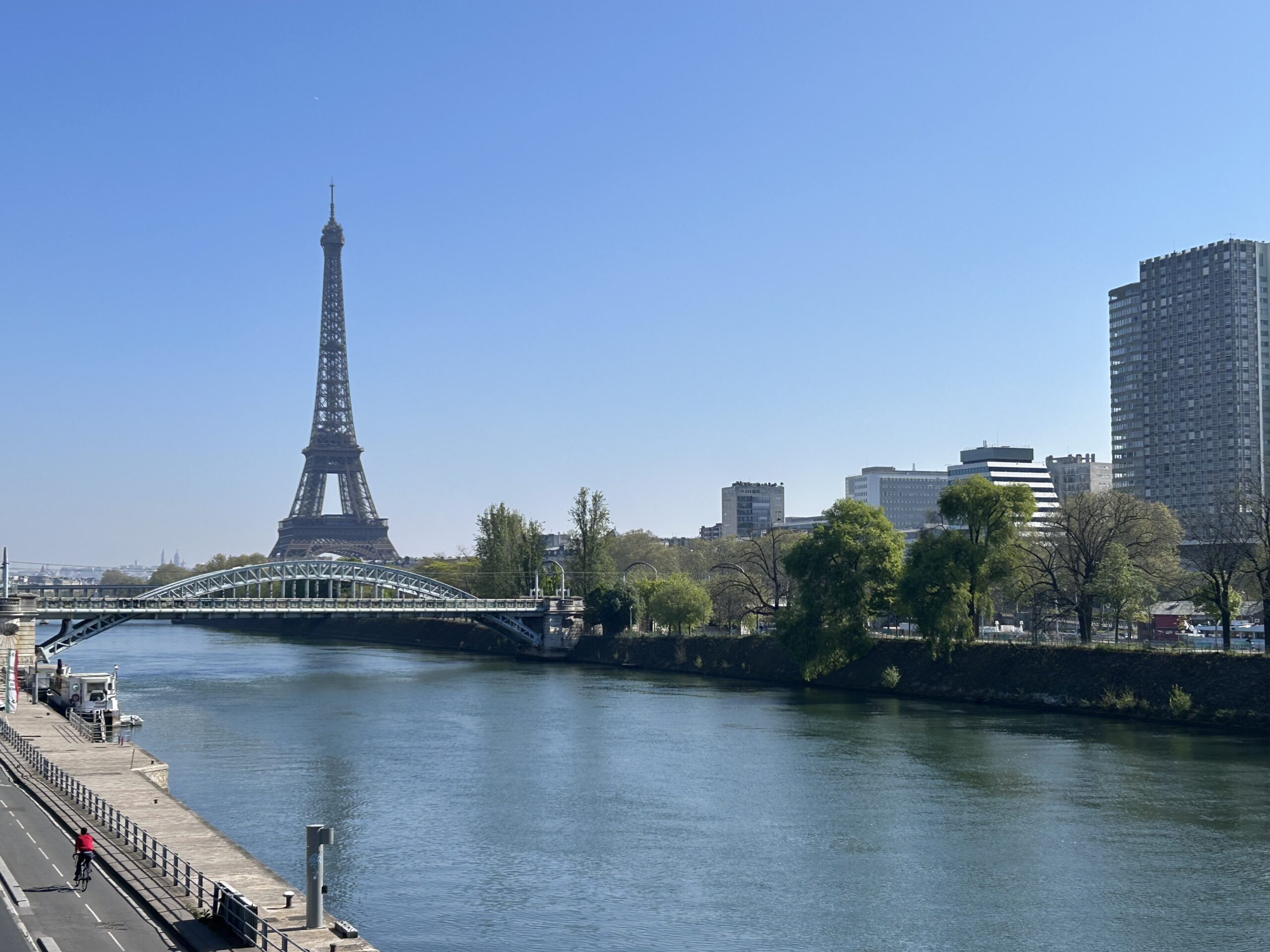
If politicians are motivated, they can find the resources to make change. The River Seine in Paris underwent a miraculous transformation—from sewer to elite swimming venue—for the 2024 Olympics. It’s amazing how readily decision-makers can find billions of euros when motivated.
We know what healthy rivers look like. We’ve seen them in storybooks and on screens. We remember them. That memory is a form of resistance against forgetting.
On our final evening in Orléans, my wife Theri and I walked back along the dyke by the Loire. Theri noticed a boy still sitting where we’d seen him earlier, near a side-channel outlet. At his feet lay a 50cm-long carp, still twitching.
“Did you catch that?” she asked.
He nodded. His name was Abubakar, from Guinea-Bissau. A student in Paris, visiting his brother in Orléans. No rod, no line—just trainers, jeans, a T-shirt. The fish had jumped close to the bank and, with a lucky kick, he’d knocked it ashore.
It was such a strange, unexpected act. Reflexive, almost primal. A single fish pulled from a river that felt nearly empty.
He said he might take it home, see if his brother wanted it. We declined when he offered. We’d talked about carp with friends earlier and agreed it wasn’t to our taste—especially not from a river as uncertain as the Loire. Predatory fish like perch or eels, I later learned, tend to concentrate the worst of the pollutants. Bottom dwellers accumulate heavy metals. Even once a year might be too much.
But there was something in that moment. The contrast between the industrial weight of the issues we’d been discussing and this single boy catching a fish with his foot. It brought everything back to scale. To a human story.
We talked for a while. Abubakar had a gentle manner and a quiet pride. He was studying engineering. His country, on the west coast of Africa, desperately needs engineers. The fish, the river, the story—they became linked.
That fish shouldn’t have been there, and yet it was. The kick shouldn’t have landed, and yet it did.
Maybe that’s what we hold onto. That some kind of life persists. That chance, or reflex, or attention can still pull something unexpected from the water.
Back in Wales, the pollution debates rage on. In Pembrokeshire, where we live, there’s growing concern over agricultural runoff—especially from intensive dairy farms. But tourism adds pressure, too. A farmer I spoke with blamed holidaymakers as much as cows. In summer, the population of our county swells dramatically. Does the infrastructure cope? Almost certainly not.
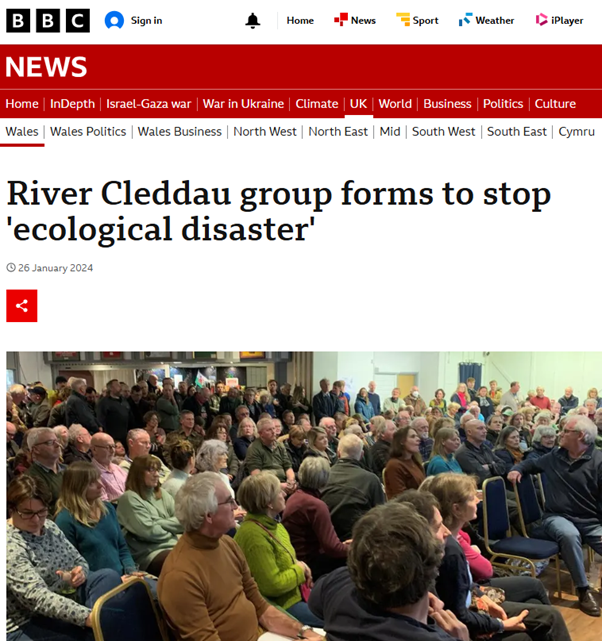
A local Pembrokeshire initiative, The Cleddau Project, established in 2024, has been documenting repeated breaches by Welsh Water treatment plants—discharging raw sewage into the river in the midst of Haverfordwest, close to the main council offices.
Overpopulation, local or seasonal, is another elephant in the room. Whether it’s livestock or tourists, the land and water can only take so much. But addressing this means facing hard truths we prefer to avoid.
And so, like so many others, I remain a half-hearted environmentalist. I know more than I act on. I see the problems, but my efforts feel too small to reverse them. And yet I keep writing. I keep testing the water in ditches and streams. I keep talking to strangers by rivers.
Because I still believe in rivers.
And I still believe we can remember what they were meant to be.