The Way of Pain
For parents, the only way
is hard. We who give life
give pain. There is no help.
Yet we who give pain
give love; by pain we learn
the extremity of love.
—Wendell Berry
This morning seemed like the right time to start.
I’ve been meaning to begin this journal for months—maybe longer. The impulse has been there, nudging at me. I’ve read so many books lately, but it’s those of Wendell Berry— that iconic American farmer, poet, environmental activist, agrarian, and successor of Thoreau—that have touched me the most this past year. I’ve also reached the age when it seems so many of our friends are writing books, so perhaps that has nudged me out of my complacency as well. Writing has been on my mind, but the question was always: when?
And then, this morning, I ran. As I often do when I have time, I set out towards Colby Woodland Garden, a National Trust property about a mile from our smallholding. This place has been part of our lives for twelve and a half years, since we moved to Wales. It’s a place of ancient woods, towering trees, and a river—though calling it a river feels generous. The Colby River is more of a large stream, but it’s beautiful. When you are alone in the valley, ‘it’ becomes ‘she,’ and there is singing as her waters rush down the valley, cascading over small weirs and disappearing under pedestrian bridges. And she is clean—not crystal clean, which is almost unheard of in the UK in this age of water pollution, but clean enough, which is a rarity in Pembrokeshire. I know this because I’m part of a citizen science group monitoring local waterways.
But Colby is more than just a beautiful place. For our family, it holds memories—happy ones. We brought our children, Malachi and Hannah, here often: walks, bat-watching, playing in the stream, eating cake at the tea rooms. It was a place of laughter and gentle exploration, a place to share with friends.
And then Colby became something else. A place of sanctuary. A place to grieve.
Malachi, our son, is no longer with us. There’s no easy way to say it—he took his own life just over two years ago at the age of 21. He was autistic, beautiful, and full of complexities. Perhaps, as I write this blog, more will emerge about our journey as a family, about the struggles Malachi faced, about the loss that blew our lives apart, and about how we are slowly coming to terms with it and reshaping our lives. But for now, what matters is this morning, this place, this bench where I sit.
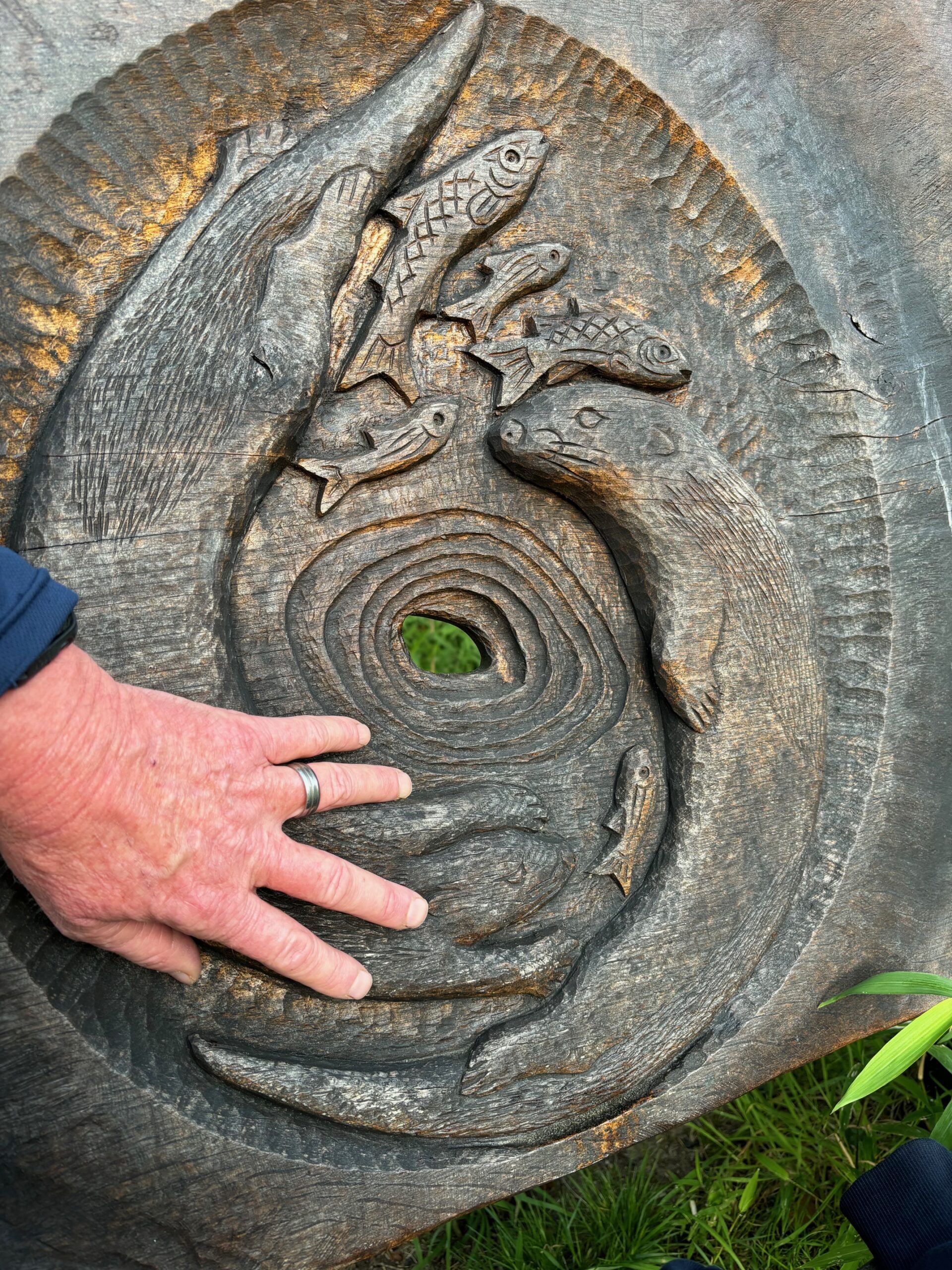
The bench is special—a piece of Welsh oak, carved with an imprint of two interlocking otters chasing trout. It stands in Colby Meadow, placed there in memory of Malachi. The otters symbolize him and his sister, Hannah—their bond, our love, our grief. On the seat, the inscription reads: Smile, Sing, Dance—our epitaph for Malachi.

Sitting here, I reflect on the promise I made—to Malachi, to myself. When you lose a child, you walk a path no parent ever imagines. Everyone finds their own way through, if they manage to get through at all. For me, there were dreams. Three of them, after Malachi passed, that helped pull me back from the edge. In the first, I walked with Jesus, and in that dream, I was forgiven—for my failures as a parent, for all the ways I fell short. And I needed that forgiveness because, of course, if I had been enough, perhaps Malachi would still be here. But in the dream, the knot in my stomach—the one that had clenched me tight since he died—unclenched. And in the second dream… well, maybe that’s a story for another day.
For now, I sit on the bench and remind myself of what drives me forward. When you lose someone you love—especially a child—you want their life to have meant something. You want to make sure it wasn’t wasted. And so, I promised Malachi, and myself, that I would use whatever time I have left to make a difference. To leave the small part of the natural world I touch in a better state than I found it.
That promise is part of what led my wife, Theri, and me to restore our smallholding—to rewild and renature the little corner of Pembrokeshire we call home. It’s a journey, one intertwined with loss and healing, destruction and renewal. And it begins here, today, with these words.
Literature Cited:
Wendell Berry (1998). The Way of Pain (Verse 1). The Selected Poems of Wendell Berry. Counterpoint, Washington, D.C.