
“People who live at the lower ends of watersheds cannot be isolationists — or not for long. Pretty soon they will notice that water flows, and that will set them to thinking about the people upstream who either do or do not send down their silt and pollutants and garbage. Thinking about the people upstream ought to cause further thinking about the people downstream. Such pondering on the facts of gravity and the fluidity of water shows us that the Golden Rule speaks to a condition of absolute interdependency and obligation. People who live on rivers — or, in fact, anywhere in a watershed — might rephrase the rule in this way: Do unto those downstream as you would have those upstream do unto you.”
— Wendell Berry, “Watershed and Commonwealth” (1997)
Today is about remembering.
I’ve been revisiting two pieces connected to the New Inn Stream report. One is a quiet reflection. The other is something altogether less polite — a reinterpretation written in the style of Edward Abbey. Both circle back to the same small body of water, a stream most people would walk past without a second thought.
The New Inn Stream is not an iconic river. It doesn’t feature in tourist brochures or sweeping landscape photography. It slips almost apologetically through woodland, fields, and hedgerows before reaching the sea at Amroth Bay. Easy to ignore. Easy to forget.
And yet, like many small streams, it was quietly telling a story.
The Niggling Unease
During the Covid lockdowns, like many families, we walked more. West Wales offered us space, air, and something resembling sanity. But as the months passed, I found myself increasingly distracted.
The streams stank.
Some were brown. Some carried a faint grey sheen. Others were choked with filamentous growths that looked suspiciously like sewage fungus. Having grown up on a dairy farm, I knew exactly what slurry looked like and, more importantly, what it smelled like.
Curiosity turned into discomfort.
Discomfort turned into a persistent, niggling question:
Why do so many streams in one of the most beautiful parts of Wales appear dirty, lifeless, and unwell?
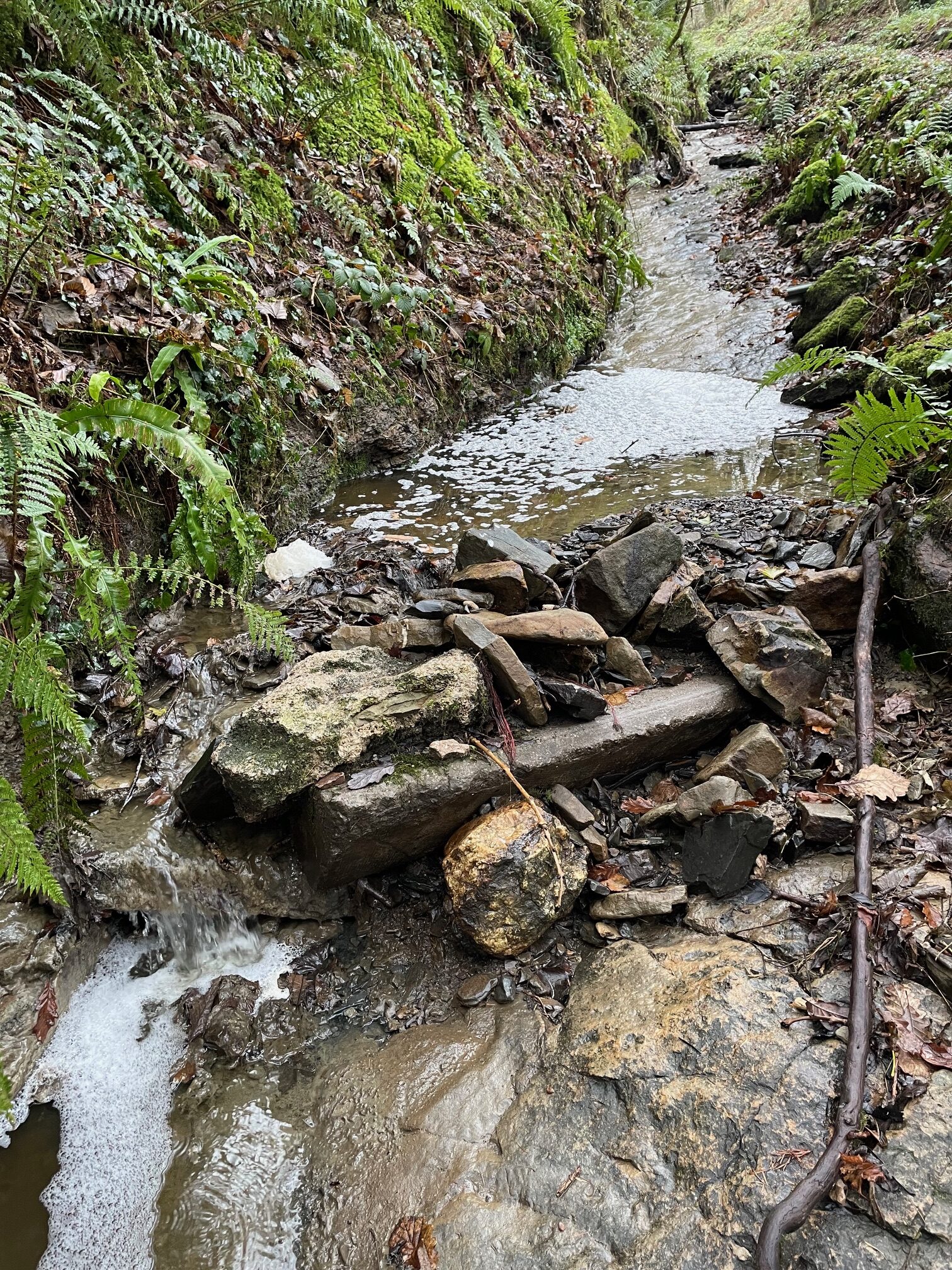
The Zoo Vet’s Test Kits
At some point, almost absent-mindedly, I began carrying a basic aquarium water testing kit — the same type I used professionally when advising zoos on aquatic animal health.
Dip. Wait. Compare colours.
The results were sobering.
If those samples had come from an aquarium, any fish inside would have been stressed, compromised, or dead. Yet this was not a closed artificial system. This was the open countryside. These were Welsh streams.
That contrast was hard to ignore.
A Conversation Over the Fence
Around that time, I chatted “water” with a neighbour, Andy, a fellow smallholder and, as it turns out, someone with his own concerns.
Andy mentioned that nitrate levels in his borehole water had been rising year on year. Eventually, a nitrate scrubber had to be installed because the groundwater — his drinking water source — was no longer considered safe.
If you live in West Wales, where intensive dairy farming dominates the landscape, it doesn’t require a great leap of imagination to consider one possible contributor.
Meanwhile, national headlines were increasingly filled with stories of river pollution, sewage discharges, and regulatory failures. It felt less like coincidence and more like pattern recognition.

“But What Can I Do?”
There is a particular frustration familiar to anyone paying attention to environmental decline.
You see the problem.
You understand the scale.
You feel the anger.
And then comes the paralysing question:
But what can I actually do?
Protest? Petition? Complain into the void?
Or something smaller. Local. Tangible.
Citizen Science and a Kitchen Table Plan
Our first practical step came via the West Wales Rivers Trust, who ran a Riverfly training session for a group of local residents at our farm.
Kick sampling. Invertebrates. Scoring systems.
Surprisingly fascinating. Educational. Occasionally fun.
But also time-consuming, dependent on sustained volunteer enthusiasm, and offering limited feedback. We found ourselves wondering:
What happens if we detect a pollution event?
Privately, conversations with scientists suggested that water chemistry monitoring — nutrients, ammonia, phosphates, nitrates — might provide clearer, more defensible data.
So we applied for a grant.
The Birth of LARC
Grant funding required a bank account.
A bank account required an organisation.
An organisation required a community.
In the summer of 2022, around 25 local residents gathered at our farm. The mood was strikingly familiar: a shared sense that things were not right.
People spoke of disappearing wildlife. Silent springs. Fewer insects. Streams that no longer resembled those of childhood memory.
From that meeting, the Llanteg and Amroth Renaturing Community (LARC) was born.
Being British, we formed a committee.
Being concerned, we formed a plan.
Being mildly aware that environmental projects benefit from better branding, we chose a name:
Keep The Streams Clean
Watching the Water
Between June 2022 and June 2023, a small group of volunteers monitored the New Inn Stream and its tributaries.
Monthly sampling.
Nitrates. Phosphates. Ammonia.
Temperature. pH. Conductivity.
What we found is documented in the report.
What we experienced is harder to quantify.

Grief Enters the Story
Four months after LARC was established, my world changed irrevocably.
In November 2022, while travelling to a professional meeting, I learned that my son Malachi had died — tragically and unexpectedly.
Malachi was a beautiful, vulnerable young man on the autistic spectrum. Like all parents, we had built our lives around loving and advocating for him.
Grief rearranges everything.
During that winter, I ran and walked daily — past fields, hedges, and streams. The rawness of personal loss became inseparable from what I saw around me.
Wounded hedgerows.
Uprooted trees.
Brown, stinking tributaries.
Ecological grief and personal grief entwined in ways I could never have anticipated.
Nature, strangely, became both accusation and refuge.
So I planted trees.
Sowed wildflower meadows.
Monitored waterways with something approaching obsessive focus.
Running and cold-water swimming helped keep the machinery of daily existence functioning.
Community Friction
Shining a light on environmental problems within a small rural community is not without consequence.
Some conversations were constructive.
Others… less so.
The level of hostility surprised me. Vitriol directed not at the data, but at the act of looking. At the discomfort created by measurement. At the implication that what had long been normal might also be harmful.
One message suggested the monitoring should stop because it was causing mental distress within the farming community.
This was difficult to hear while navigating the aftermath of losing a child.
But it reinforced something important:
Environmental damage persists not just through ignorance, but through collective silence.
Most of us would not walk past violence in the street and do nothing. Yet we routinely walk past polluted streams without recognising them as sites of harm.
We have become profoundly disconnected from the natural systems that sustain us.
What Changed?
Two years on, there are cautious signs of improvement.
The stream runs clearer.
Obvious effluent discharges have not been observed.
Behaviour appears, in some cases, to have shifted.
Community attention matters.
Citizen science matters.
Even imperfect, uncomfortable conversations matter.
What Citizen Groups Can — and Cannot — Do
Our monitoring did not pretend to solve systemic problems embedded in modern agriculture, waste management, and regulatory frameworks.
What it could do — and did — was:
- document
• inform
• provoke discussion
• remove plausible deniability
And unexpectedly, it inspired other local monitoring efforts.
These are not small outcomes.

Not Against People
Before one is accused of being “anti-farmer” or “anti-community”, let me be clear:
I am not against people.
I am against systems that normalise environmental degradation.
Against economic models that externalise ecological costs.
Against the quiet drift into accepting poisoned rivers as inevitable.
Looking Forward
This series of blogs returns to the New Inn Stream from different angles — reflection, reinterpretation, memory, data, discomfort, and, occasionally, hope.
Because streams are rarely just about water.
They are about how we live.
What we tolerate.
What we choose to see.
And sometimes, what grief compels us to confront.
Acknowledgements: To all the members of LARC who have been involved with water monitoring projects and the wider community of LARC supporters who care about our local environment. This article has come out of a number of pieces, but is broadly based on a talk I gave in 2024 to the British Veterinary Zoological Society at their annual conference in Birmingham entitled: Community Nature Recovery: But What Can I Do? Establishing a Community Nature Recovery Group and using Citizen Science to engage a community in the biodiversity crisis affecting West Wales (authors: Tom Bailey and Kevin J. Caley).
The full Citizen Science report, New Inn Stream Water Quality Monitoring Project (‘Keep The Streams Clean’), is available here:
https://www.greensheepcamping.co.uk/category/information-reports/
