
The New Inn Stream (after Edward Abbey)
The New Inn Stream is not famous. It has never inspired a postcard, a pilgrimage, or a sentimental poem written by someone who drove here in a hybrid and felt absolved by the scenery. It is a ditch with ambitions—a narrow, persistent ribbon of water leaking out of springs in forgotten corners of fields, places where farmers don’t look and planners don’t care. From there it does what water has always done: it accepts everything.
Rain falls on Pembrokeshire and the stream dutifully collects the consequences. It gathers what gravity offers—soil, leaves, sticks, carcasses—and what human beings shed without a second thought: plastic, slurry, herbicides, pesticides, sewage, pharmaceuticals, and the assorted chemical breadcrumbs of modern life. The stream does not discriminate. It does not moralise. It simply receives.
As its tributaries slide downhill toward Tavernspite, they combine into the channel locals politely call the New Inn Stream. It passes through woods that try—valiantly but increasingly futilely—to buffer it from what comes off the land above. It flows past fields treated as factories, roads treated as drains, gardens treated as laboratories. Eventually it reaches the New Inn pub, where people drink, chat, and look at the water without really seeing it, before it empties itself—obediently, silently—into the sea at Amroth Bay.
By the time it arrives there, the stream is no longer water in any meaningful sense. It is a broth. A dilute record of our agriculture, our consumer habits, our medicine cabinets, our waste systems, our indifference. Microplastics drift alongside insect larvae that never stood a chance. Antibiotics mingle with fertiliser. Hormones, detergents, and pesticides swirl together in a chemical signature that might as well be labelled: Homo sapiens, 21st century.
We like to talk about “nature” and “pollution” as though they were separate categories. The stream knows better. It mixes everything thoroughly. It is the accountant that keeps our books when we refuse to. Every discharge, every shortcut, every regulatory failure is logged and carried downstream.
This is not a tragedy of ignorance.
It is a tragedy of convenience.
The New Inn Stream may be small and overlooked, but it is ours. Not in the romantic sense—no pastoral nonsense about stewardship—but in the practical sense of responsibility. If you look into its water, you are not seeing a wilderness ruined by abstract forces. You are looking at a mirror held up to a community, an economy, and a way of life that insists on externalising its mess.
The Llanteg and Amroth Renaturing Community monitored the New Inn Stream during 2022 and 2023 and published a report ‘Keep The Streams Clean‘ in 2024 that was released to the community and interested parties. The report was a technical document, full of methods and measurements, but it was also a quiet indictment. It asked a simple question: why does a stream that once should have been crawling with life now feel empty?
The answer is neither mysterious nor comfortable. It is embedded in how we farm, how we manage waste, how we regulate—or fail to regulate—ourselves, and how large institutions deflect blame while continuing business as usual.
We did not pretend that this report would fix anything. Reports do not save rivers. At best, they remove the final layer of denial. And denial, like most pollutants, spreads easily.
The findings made some members of the community uncomfortable. A spotlight has a way of doing that, particularly when it illuminates practices long tolerated as “business as normal”: industrial farming systems that produce more waste than the land can sensibly absorb, too many cattle, too much slurry, too little space, and a climate increasingly generous with rain to wash the excess where gravity has always intended — downhill, into streams, and eventually into the sea.
What we politely call runoff is, more often than not, simply pollution in motion.
Once the data are visible, once the condition of the stream is named plainly, silence becomes harder to justify. Silence, after all, is not neutrality. It is permission.
Before reading further, you are invited to read Tawelan Brook, a recollection of a childhood stream full of life, complexity, and memory. Read it carefully. Then ask yourself the uncomfortable question: not what happened to the stream? but what did we do to it—and why did we allow it to happen?
Because the stream is still talking.
The problem is not that it has lost its voice.
The problem is that we have trained ourselves not to listen.
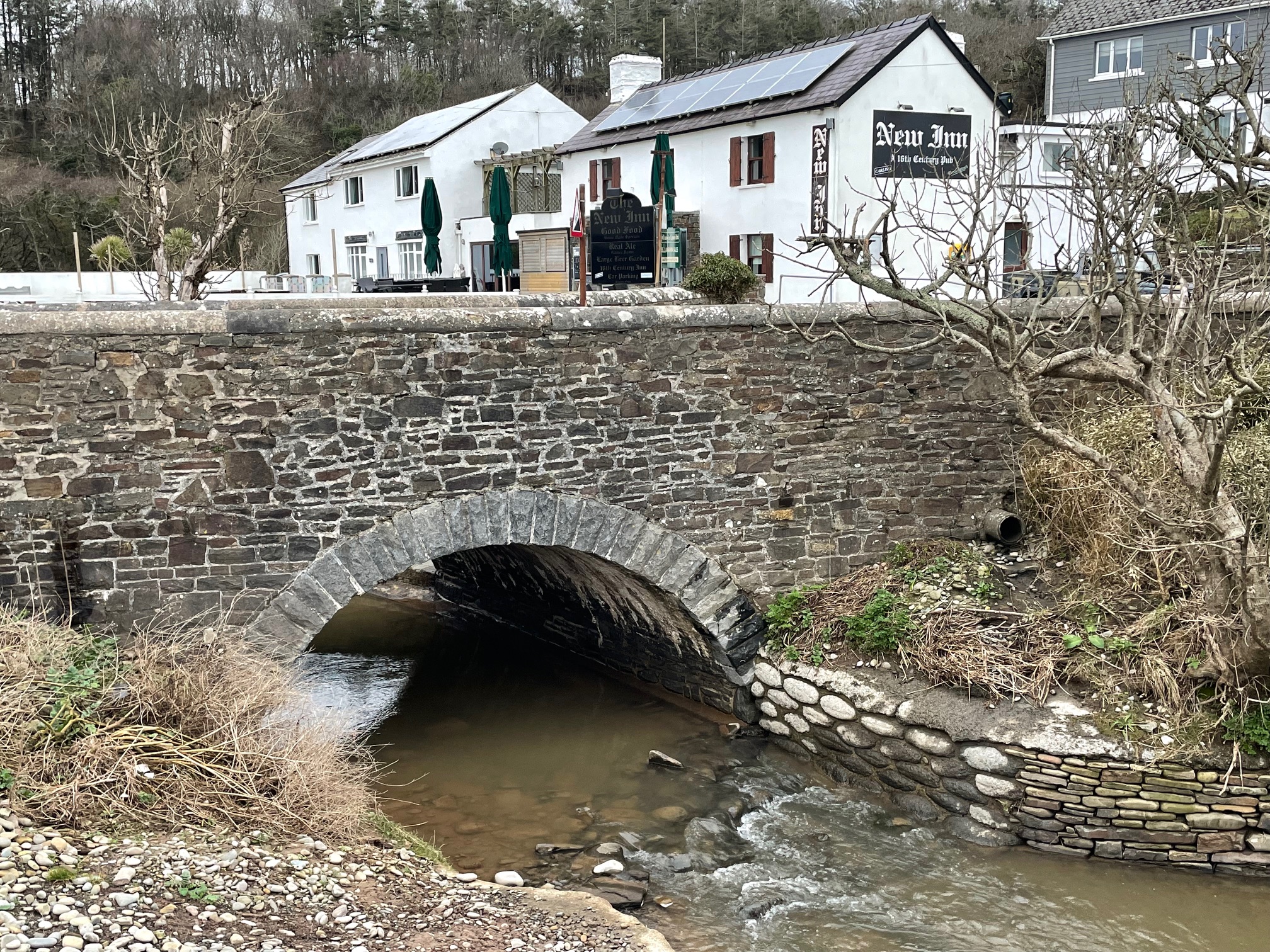
To read and download a copy of the New Inn Stream Report visit:
(https://www.greensheepcamping.co.uk/keep-the-streams-clean/)
Acknowledgements: Human mischief, Edward Abbey, AI assistance: this piece was created by the author with help from ChatGPT.