
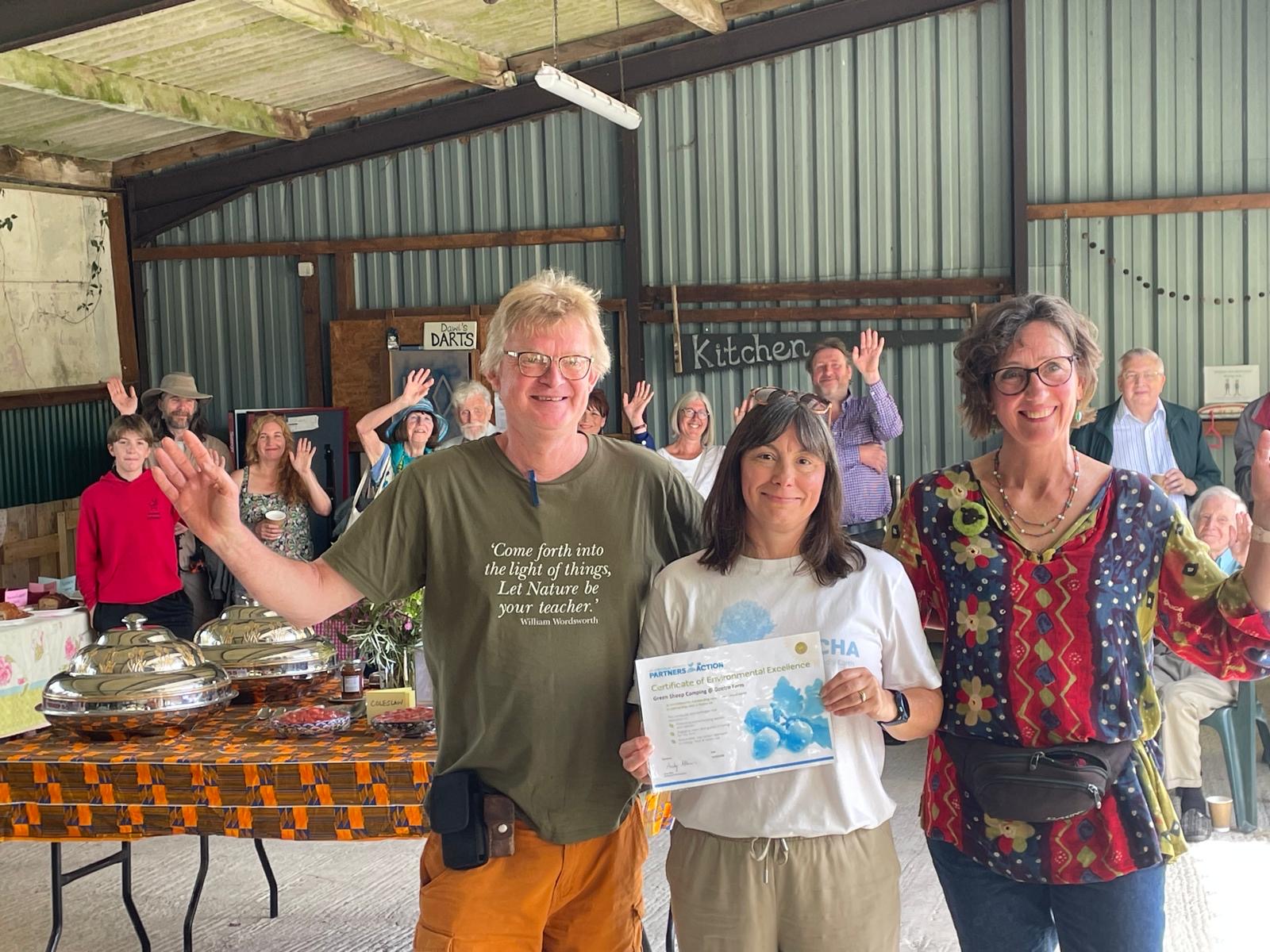
On Sunday 14th June we were delighted to welcome around forty family members, friends, neighbours and fellow travellers to Green Sheep Camping and Goetre Farm to celebrate becoming a Partner in Action with the Christian conservation charity A Rocha UK.
The day was never intended to be a formal launch. Rather, it was an opportunity to pause, give thanks and celebrate the journey that has brought us to this point. Over the past fourteen years, Goetre Farm has slowly become a place of nature restoration, hospitality, community and healing. Becoming a Partner in Action feels less like joining an organisation and more like publicly affirming the direction in which we hope our lives, our faith and this smallholding will continue to grow.
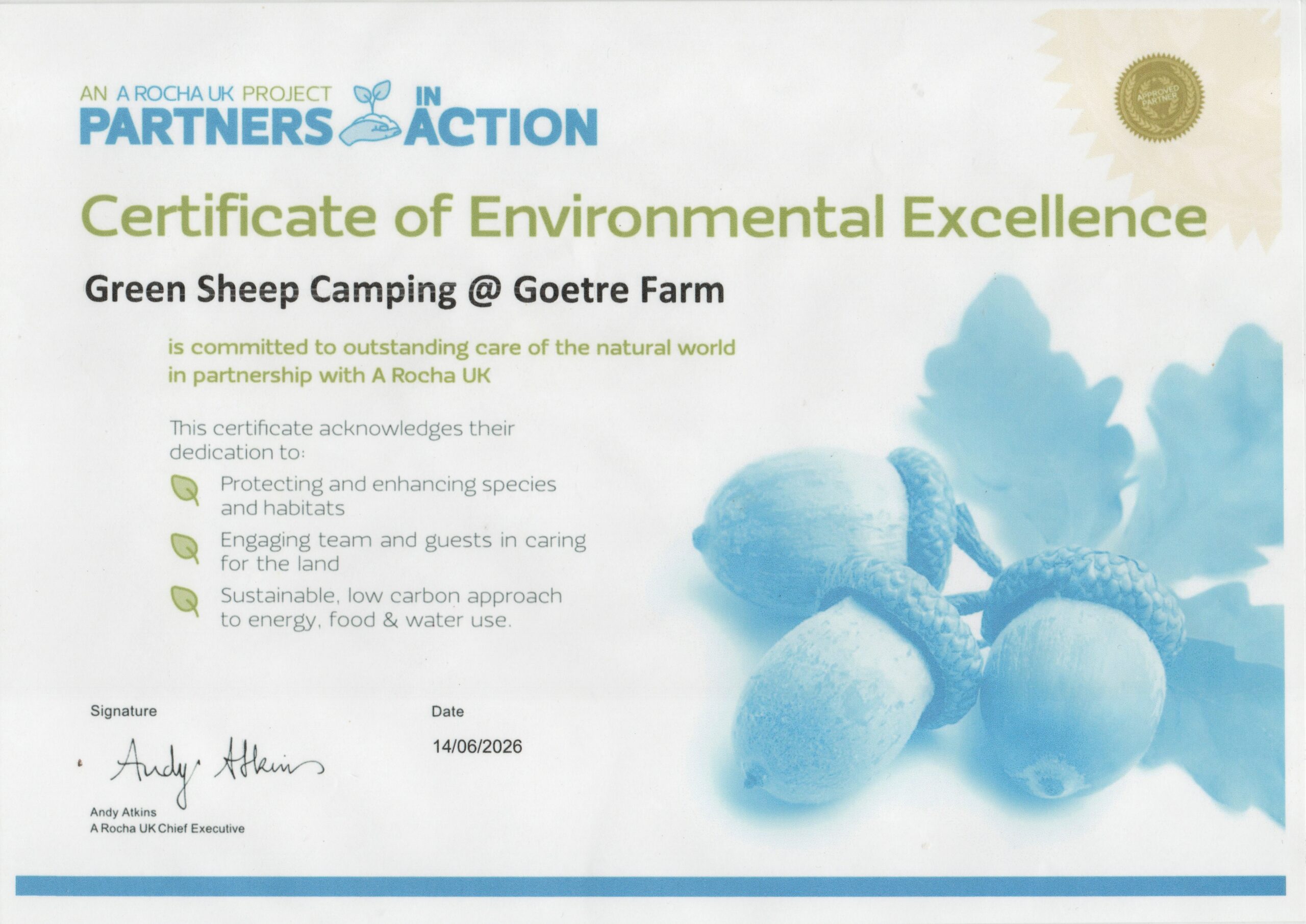
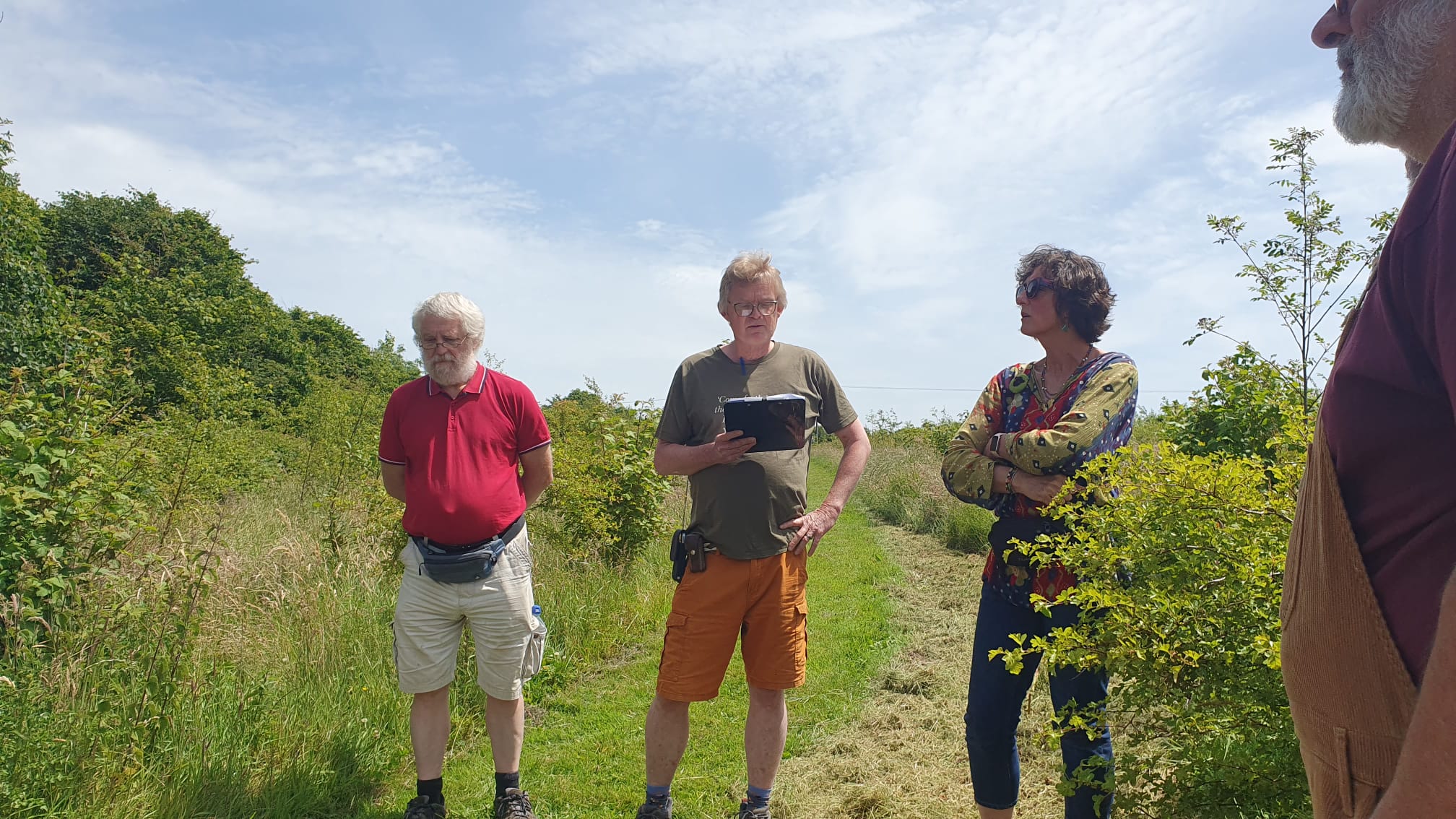
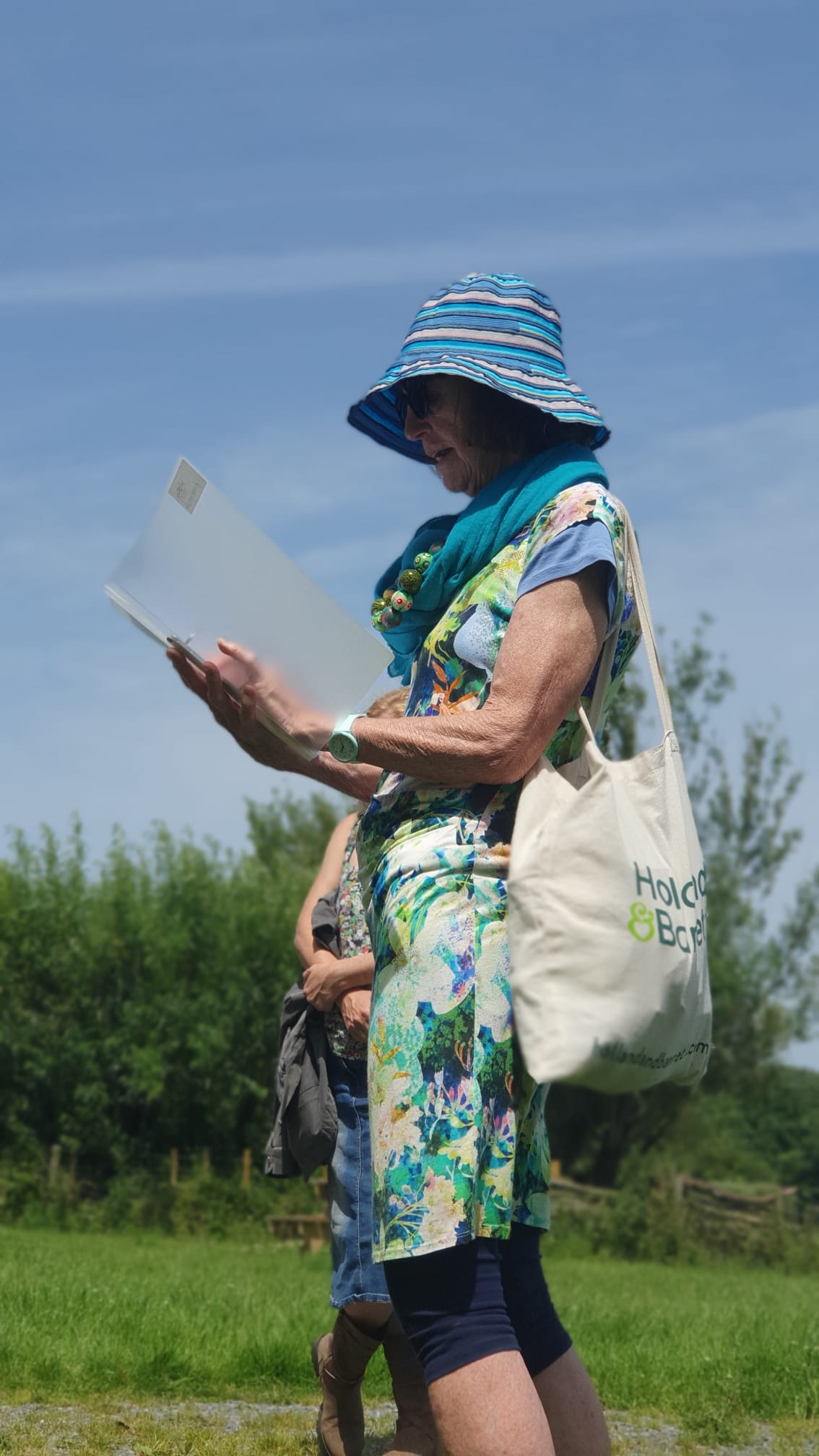
After coffee and cake in the barn, Delyth Higgins from A Rocha UK presented us with a ‘Certificate of Environmental Excellence’ before we set off on a gentle pilgrimage around the farm. We paused at four places that have become especially significant to us: our wildflower meadow, Malachi’s Wood, the ponds and our ancient woodland overlooking the valley. At each stop we shared invitations to notice, short reflections, Bible readings, prayers and words of thanksgiving.

Many people who joined us afterwards asked if we could share the words from the pilgrimage. We have therefore reproduced them below, more or less as they were spoken on the day, in the hope that they may encourage others to slow down, notice God’s presence in creation and perhaps be inspired to care for the small corner of the world entrusted to them.

1st Stop — Wildflower Meadow
Abundance, Hope and Small Acts
We gather at the edge of the meadow and take a moment simply to look and listen.
Invitation
Take a moment to notice: one insect, one flower, one sound. No need to report back. Simply noticing is enough.
Reflection
Thank you for coming and sharing this day with us. Becoming Partners in Action with A Rocha UK feels less like joining an organisation and more like publicly saying: this is the direction we want our lives to lean. We are trying, imperfectly, to care for this patch of earth entrusted to us. This meadow was once a riding arena. Today it is full of wildflowers, bees, butterflies and birdsong. It reminds us how quickly life can return when given space, light and patience. Creation has an extraordinary willingness to heal — though not endlessly, and not without our help.
One of Tom’s favourite writers, the American farmer, poet and environmentalist Wendell Berry, wrote:
“The care of the Earth is our most ancient and most worthy, and after all, our most pleasing responsibility.”
That idea lies at the heart of why we are here today.
Giving Thanks
As we go on our little pilgrimage around this land, we would like to take the opportunity to thank and be grateful for many things. Firstly, we acknowledge you, our family and friends who are journeying with us. Also, that our family is only the latest people who have lived on, worked on and stewarded this land. As far as we understand, the oldest bit of the Goetre farmhouse was built in 1680 so there are generations of families who have lived here before us. We are collecting the names of families who have dwelled on this land and give thanks for the; Rogers, Skymes, Gwyther, Howells, Rees, Oriels, Griffiths, Lewis, Mussons, Credlands and Enfields. We also give thanks and honour the thousands upon thousands of animals and plants, both wild and farmed that have dwelled in this place. Our own time at Goetre is barely a blink in the long history of this place. We receive it with gratitude, and we hope to pass it on in better heart than we found it.
Reading — Matthew 6:25–34
Do Not Worry
25 “Therefore I tell you, do not worry about your life, what you will eat or drink; or about your body, what you will wear. Is not life more than food, and the body more than clothes? 26 Look at the birds of the air; they do not sow or reap or store away in barns, and yet your heavenly Father feeds them. Are you not much more valuable than they? 27 Can any one of you by worrying add a single hour to your life[e]?
28 “And why do you worry about clothes? See how the flowers of the field grow. They do not labour or spin. 29 Yet I tell you that not even Solomon in all his splendour was dressed like one of these. 30 If that is how God clothes the grass of the field, which is here today and tomorrow is thrown into the fire, will he not much more clothe you—you of little faith? 31 So do not worry, saying, ‘What shall we eat?’ or ‘What shall we drink?’ or ‘What shall we wear?’ 32 For the pagans run after all these things, and your heavenly Father knows that you need them. 33 But seek first his kingdom and his righteousness, and all these things will be given to you as well. 34 Therefore do not worry about tomorrow, for tomorrow will worry about itself. Each day has enough trouble of its own.

2nd Stop — Malachi’s Wood
Grief, Planting and Resurrection
Invitation
There are seven and a half thousand trees of twenty-four species of native tree growing in this young woodland. Take a few moments to walk amongst them and notice how different they are. Although they began their time in this former dairy cow grazing field as small saplings no more than six inches tall, many are now taller than us, and with good fortune they will outlive us all. As you walk, pick up a fallen leaf and notice its shape, colour and texture. Notice the diversity that has emerged from what was once an empty, grass monoculture field.
Reflection
In January 2022 we planted this woodland. Malachi, Hannah and visiting friends, along with a team organised by our friend Jerry Roberson. Malachi died in November that same year, and these young trees have become a living memorial to him. In 2023 we approached the Ordnance Survey and this area is now officially named Malachi’s Wood. Grief changes the landscape of your life. There is no tidy theology for it. No fixing it. But planting trees and restoring wildflower meadows became one way of continuing to love Malachi, our beloved son. These young trees are small acts of faith in a future we may never fully see. Christian hope, at its best, is perhaps less about certainty and more about choosing to plant anyway. As our friend, Lena, told us she had prayed she hopes that the trees ‘Will whisper Malachi’s name forever’.
Poem
That first winter after the planting and loss of Malachi, this was a bare windswept space. Small finger-high trees held captive in a forest of plastic tree guards that rattled eerily in cold winter winds. Now just four years later look around and see this transformed field, a place of trees and flowers. A place of healing where last year Tom wrote this poem after walking down this track through this woodland. Tom reflected on how nature has been part of our family’s journey through grief and healing.
Where We Find Hope (by Tom Bailey)
Where do we find hope
But in the broken ground of our dreams,
Where winter fields have churned to mud,
Poached and furrowed by the feet of restless sheep.
And we scatter the wildflower seeds, blown
With the ash of our beloved son, lost,
And plant the sapling trees,
To be watered by the rain of grieving tears
And blessed by the birdsong of spring.
And wait—
The long wait—
Until one year ends,
And one begins,
When our hope springs forth
In bright yellows, pinks, and greens.
Reading — John 12:20–28
20 Now there were some Greeks among those who went up to worship at the festival. 21 They came to Philip, who was from Bethsaida in Galilee, with a request. “Sir,” they said, “we would like to see Jesus.” 22 Philip went to tell Andrew; Andrew and Philip in turn told Jesus.
23 Jesus replied, “The hour has come for the Son of Man to be glorified. 24 Very truly I tell you, unless a kernel of wheat falls to the ground and dies, it remains only a single seed. But if it dies, it produces many seeds. 25 Anyone who loves their life will lose it, while anyone who hates their life in this world will keep it for eternal life. 26 Whoever serves me must follow me; and where I am, my servant also will be. My Father will honor the one who serves me.
27 “Now my soul is troubled, and what shall I say? ‘Father, save me from this hour’? No, it was for this very reason I came to this hour. 28 Father, glorify your name!”
Reflection on the Reading
Jesus chose the image of a seed falling into the earth. He spoke of grief, loss and death not through abstraction, but through the living patterns of creation itself. In woodlands and meadows we see this mystery constantly: fallen trees feeding soil, seeds disappearing into darkness before growth, life returning in forms we could not fully predict. This place holds grief for us. But it also holds birdsong, growth, shelter and future life. Just before speaking about the seed falling into the earth, Jesus says, “Now my soul is troubled.” Even here there is no denial of sorrow, no pretending that loss does not hurt. Perhaps resurrection is sometimes less like escape from the earth, and more like love continuing to take root within it.
Giving Thanks
We give thanks to the Welsh Government, whose woodland creation grant made the planting of this woodland possible. We also give thanks to Stuart and Barbara for the Canadian Maple, the Thursday Club ladies for the Japanese cherry, Polly for the Guelder rose, Penny and Ian and Marion for the beech trees and the Llanteg village community for the aspen whose dancing leaves remind them of Malachi dancing and singing through the village. We also give thanks to our friends in LARC, who have helped monitor the harvest mice that have returned to these young woods, reminding us that when habitat returns, wildlife often follows. We give thanks for the National Park authority and it’s staff . It is a privilege to live in the National Park as we have received support, help and advice from their wonderful rangers and conservation officers. Our local National Park Ranger, Chris Taylor, has coordinated students and volunteers from Pembrokeshire College, the Duke of Edinburgh award scheme and his own National Park volunteers to remove the plastic tree guards.
Celtic Reflection
The Celtic saints often understood trees as companions in prayer — living witnesses across generations. They prayed amongst them, travelled between them and saw them as signs of God’s continuing presence in the world. We hope this woodland becomes a place of shelter, song and life long beyond us.
Silence
We keep a minute of silence.
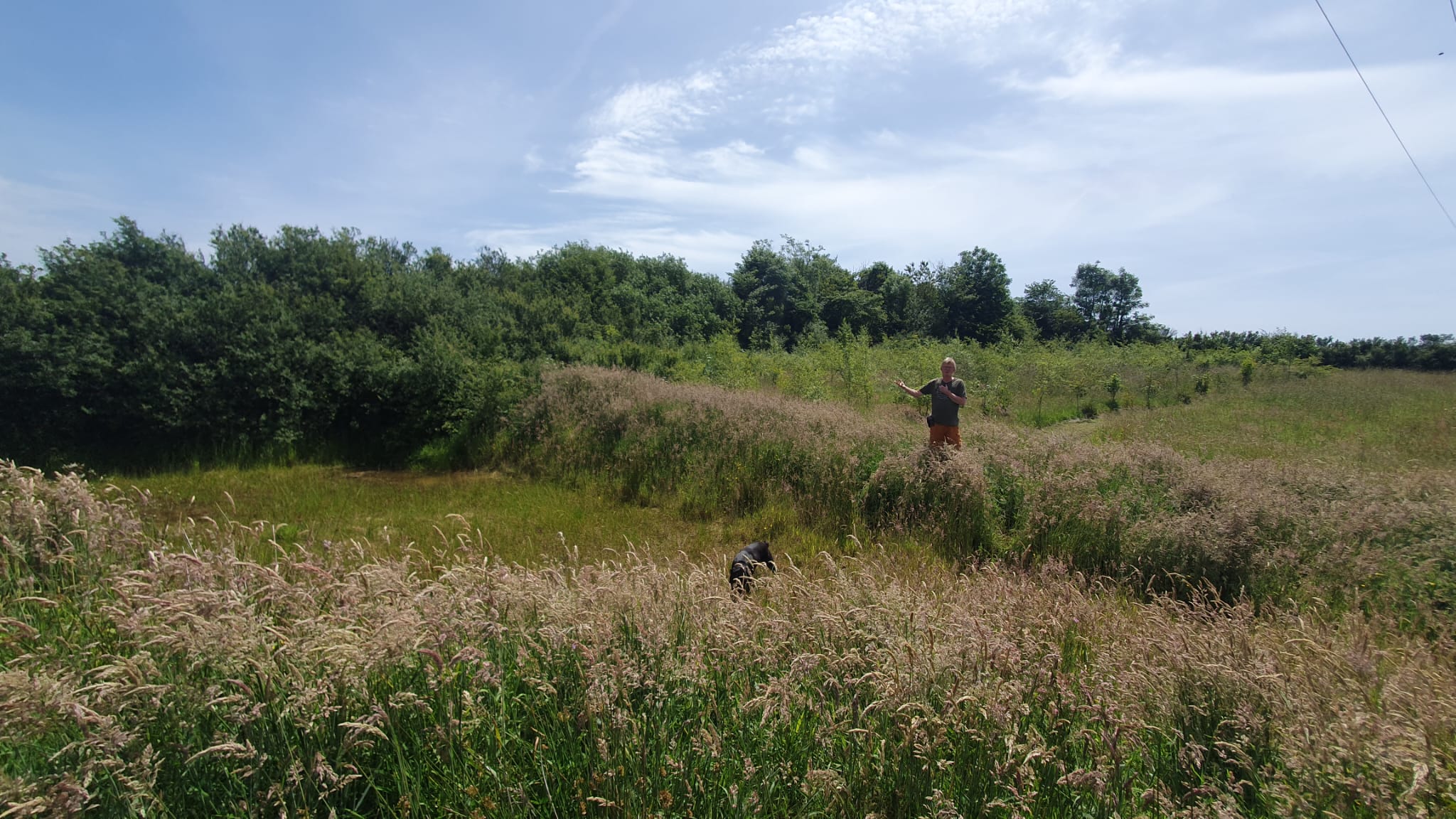
3rd Stop — Water and the Ponds
Restoration, Hidden Life and Living Water
Reflection
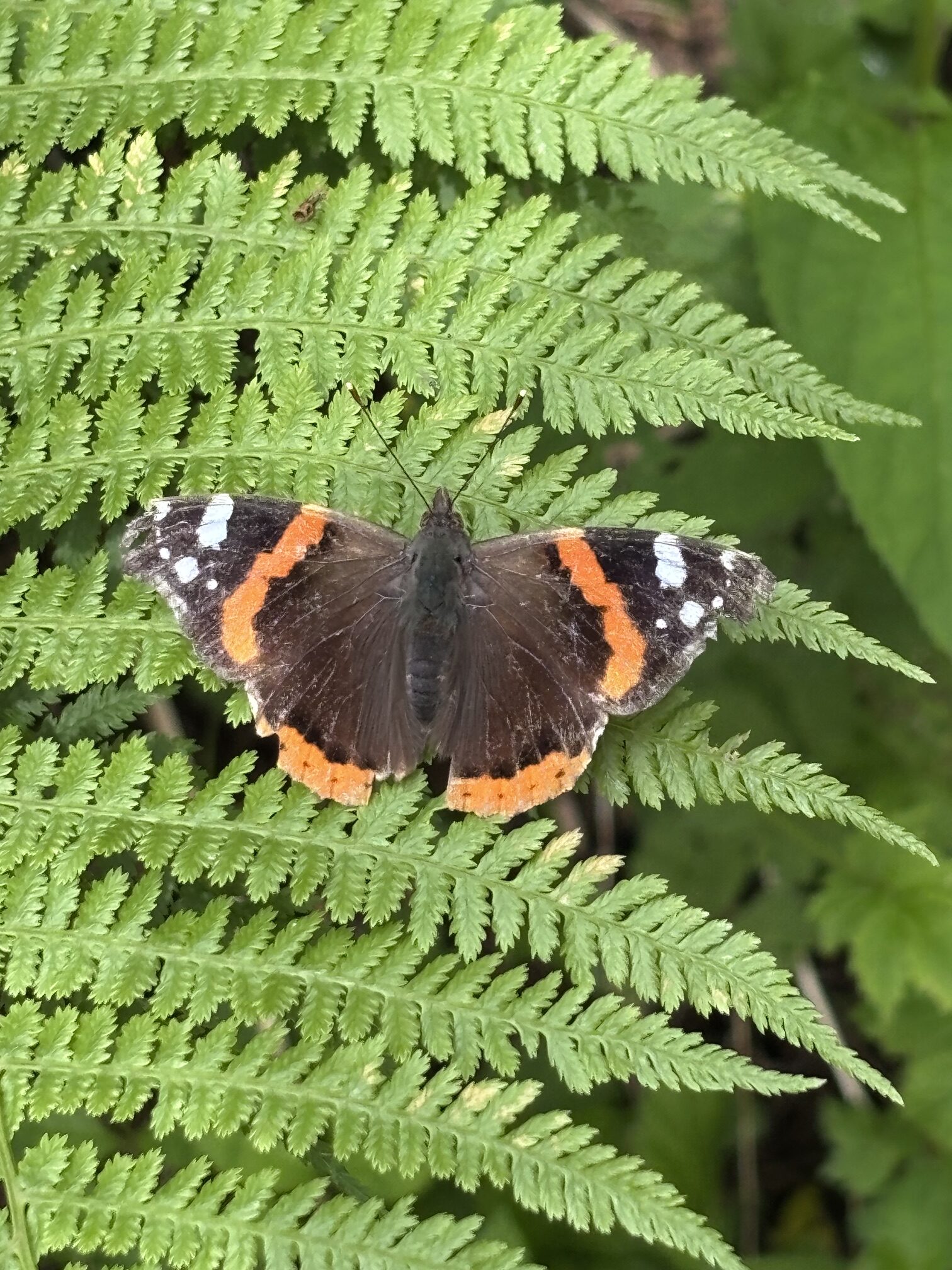
One of the things restoration teaches us is humility. You can create the conditions for life, but you cannot command life itself. You dig a pond, scatter seed, plant a tree and wait. Then, somehow, life arrives. These ponds were bare earth not long ago, yet already they are becoming home to insects, birds, amphibians and countless unseen organisms. Again and again, nature reminds us that life is remarkably willing to return if given the chance. Perhaps grace often works in much the same way.
Reading
Genesis 2:8–10
“Now the Lord God had planted a garden in the east, in Eden; and there he put the man he had formed. The Lord God made all kinds of trees grow out of the ground — trees that were pleasing to the eye and good for food. In the middle of the garden were the tree of life and the tree of the knowledge of good and evil.
A river watering the garden flowed from Eden; from there it was separated into four headwaters.”
John 7:37–38
Jesus stood and said in a loud voice, “Let anyone who is thirsty come to me and drink. Whoever believes in me, as Scripture has said, rivers of living water will flow from within them.”
Reflection on the Readings
Both of these passages begin with water. In Genesis, water flows through the garden and brings life. In John’s Gospel, Jesus speaks of living water flowing through human lives. Water connects everything. It links clouds, streams, ponds, soil, plants, animals and people in one great cycle of giving and receiving. Without water, landscapes wither. Without hope, communities and people can do the same. Perhaps part of restoration is learning again how to become people through whom life can flow rather than be blocked.
Giving Thanks
We give thanks for people who have worked with us at Goetre farm and become our friends. Thank you to people like Jerry the forester, Steve the tree surgeon, Simon the builder, Alan and Steve the fencers, Gareth the hedge-cutter, Owen the shepherd and Trevor the meadow maker and pond digger. Trevor, you have shared your knowledge, encouragement and practical help over many years. Trevor helped establish the wildflower meadows by transferring seed from the old sand school into the woods and camping fields, and he also excavated this scrape and, on the other side of the hedge, a new pond last summer. His work is a reminder that restoration often begins with small acts of care carried out quietly and consistently over many years.
4th Stop — Veteran Oaks and Ancient Woodland
Time, Memory, Community and Humility
Standing overlooking the valley, ancient woodland and surrounding community.
Bible Reading —Isaiah 55.
12 You will go out in joy and be led forth in peace; the mountains and hills will burst into song before you, and all the trees of the field will clap their hands.
Reflection
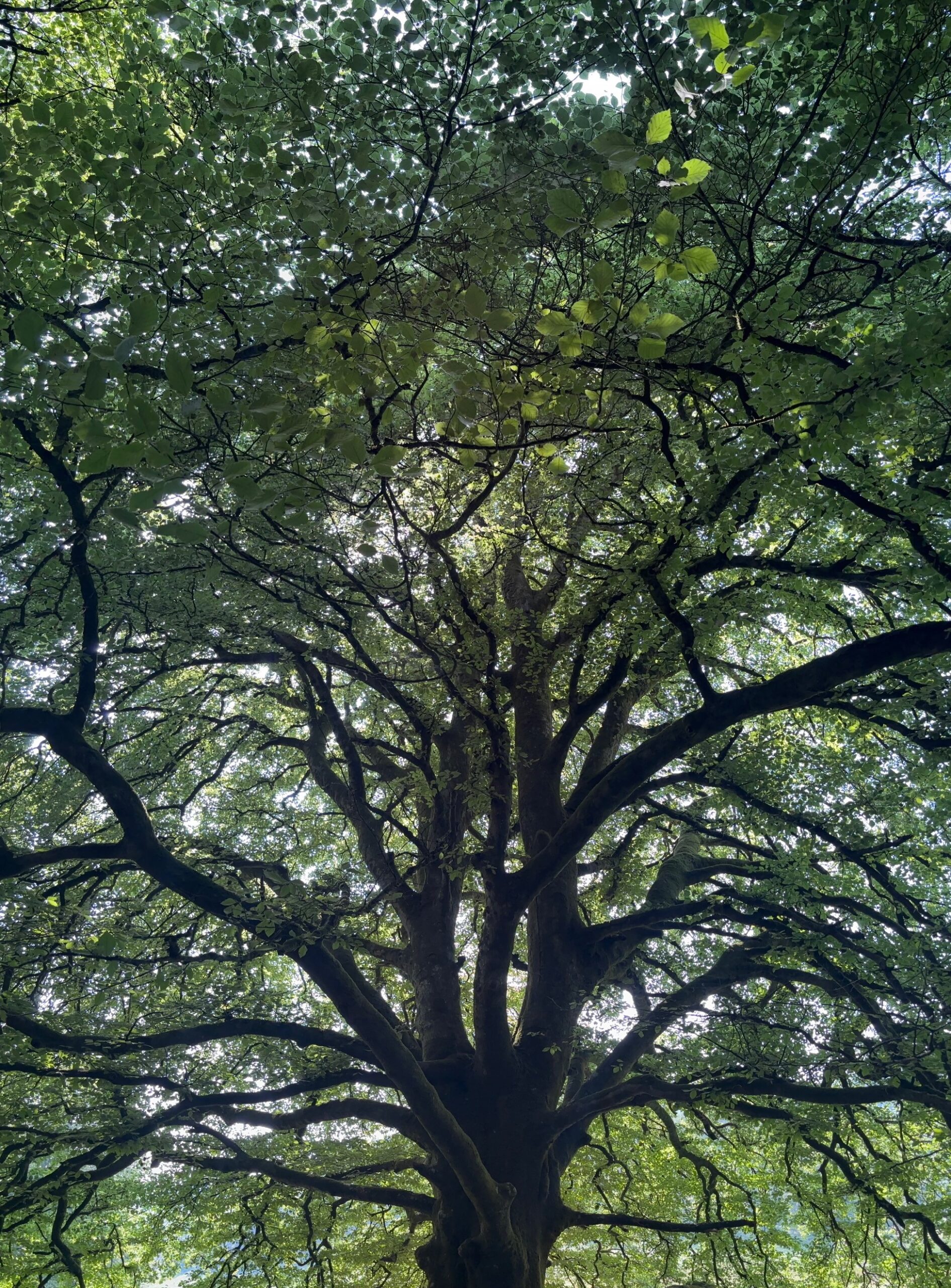
In the valley that slopes away from us down to the stream that runs into the river and then to the sea are some ancient oak trees. These oaks were already here before any of us arrived on earth. They have outlived generations of people, weather, politics, certainty, grief and joy. Ancient woodland reminds us that we belong to a much older community of life. Part of faith may simply be learning again how to be small — not insignificant, but properly placed. From here we look out not only over woodland and fields, but over homes, farms, neighbours and the wider community that shapes this landscape with us. The valley below us has been shaped by countless lives: people who planted hedges, worked the fields, raised families, cared for livestock, planted trees, dug drains, built walls and left their mark upon this place. Today we add our own small chapter to that story. May we learn again how to live as good neighbours — to one another and to the living world around us.
Poem by Rosemary Graham.
Our friend Rosie asked if she could read this poem she had written for the occasion. She did not know how we had arranged the reflective elements of the walk and it was uncanny how her words resonated perfectly with the themes of the day as she read it while we looked out over the wooded valley towards “Marros ‘mountain’”.
Landscapes of my mind.
From frozen winter landscapes of icy moss and jaded heather,
where since ancient days feet have trod their way in booted feet or
summer sandalled with dusty toes, and barefoot children scampered the slopes,
imagination high, to sledging edging fern and rock. I wonder at the enormity:
the mass of land deformed by time and movements shifting way below.
Does man at large appreciate the sense of scale of one mighty hand?
The spread of land, its coloured shale and beds of rock, rushing rivers sprung
up high beneath skies of gold with evening reds or molten thundery black.
Can he know the depth of such, the richness, the ever sounding silent songs
coursing valleys, green backs slopes, where sheep and lamb graze
their woolly days while skylarks wing the blue, and metalled outcrops
stop the fall of boulders from great heights way up beyond?
Autumn shades of rural russets, browns, and orange glow a gracious show.
Walkers chatter-ramble, tackle the tops, mapped, rucksack backed.
Have they a clue? Do their thoughts give space? Path pioneers,
of their own adventures, never cease singing, experiencing.
I, cannot but wonder at that creative hand beyond our knowing.
Rosemarie Graham
Celtic Reflection
In Celtic tradition, trees were often understood as places of wisdom, memory and presence. They were not worshipped, but honoured as part of God’s living creation. The ancient Celtic Christians often prayed in forests, beside streams and beneath solitary trees. They understood that creation could be a companion in prayer and a teacher of humility. The old Ogham alphabet of Ireland and western Britain associated letters with different trees, reflecting a culture that paid close attention to the character and gifts of the natural world. Perhaps these old trees still have something to teach us: patience in a hurried age, rootedness in a restless world, and the wisdom of belonging to something greater than ourselves.
Closing Thought
As we stand here overlooking the valley, may we remember that we are not separate from this landscape but part of it. Like the trees, we are rooted in particular places. Like the trees, we depend upon one another. And like the trees, we are called to leave shelter, beauty and life for those who come after us.
As we look out over this wooded valley towards Marros ‘mountain’ we’d like to end our reflection with a short quote from Richard Rohr, the Franciscan founder of the Centre for Action and Contemplation – “Creation is our first and final cathedral. Nature is the one song of praise that never stops singing.”
A blessing to be said by all over this valley
May this valley be blessed.
May those who work this land be blessed.
May those who struggle here be blessed.
May those who call this place home be blessed.
The Grace
Back in the barn our friend Peter Sargeant said this Grace before we ate lunch:
Let us slow down …………… let us stop a moment
The creations Creator has provided for us………
An extravagance of colours, flavours textures and smells before us.
The great I Am ………. is the Source of all good things, including our food.
Slow down and enjoy this nourishment.
We thank Him for the meal we are about to enjoy.
Amen. It was a wonderful day
If you would like to visit Goetre Farm, join one of our Forest Church gatherings at Cilrath Farm, or learn more about Green Sheep Camping and our journey of nature restoration, we’d love to welcome you.
Thanks to Drs Carolyn and Howard Mowbray and Dr Jane Bates for sharing some of the images used in this post.
